Juggling Justice and Counting Units

About a decade ago, when I had just graduated from college, I would have dismissed the idea of joining the judiciary. Barring the Civil Services, I did not consider any other possible career path. Law firms seemed too back-breaking, and litigation was too clumsy for my liking. Teaching was an option, but it offered a slow career path and did not provide the convenience of choosing my location. Civil Services was always the preferred choice, but it had the slimmest of chances of working out. And it did not.

The judiciary was not something I disliked, but I felt too incapable of pursuing it. For one, it appeared to be a never-ending pit that would offer more than I could handle. Even if I could, justice delivery seemed like an exhausting desk job. Despite these feelings, life led me down a path that eventually ended in the judiciary. And now, when I look back, it feels as though my perspective was too naïve. What had seemed like mountains turned out to be molehills, with far greater challenges waiting ahead.

Subordinate judges in India work under an illusion of justice. It is a façade created by all the actors, as actual justice delivery is often predetermined by considerations that have already taken place. The free will of a judge is deep, but not wide. That is to say, it is easier for the accused to influence witnesses and turn them hostile than for the victim to assert their case. For judges, it is merely a matter to be shrugged off. What can really be done when witnesses have turned hostile and feigned ignorance of everything that happened? Despite this, we record the testimony of the Investigating Officer, collect the requisite units allotted for that matter by showing it as a ‘contested’ case, and celebrate the disposal. Where did the justice go? Error 404.

The world uses the phrase ‘devil’s advocate’ as an idiom. I see it as a fact in my court. The lawyers, and their ways of working, resemble feudal lords. Trial court litigation is rarely about the merits of the matter; it revolves around procedural gamesmanship. A lawyer who can successfully use procedure to their advantage, either to delay or expedite a matter, wins the battle. A judge may lay down several directions for a speedy trial, but the lawyers are immune to them. What is to be done when the plaintiff is not producing any evidence? Dismiss the suit for default, sure. Does the lawyer flinch? No, they file a restoration petition. What should happen when the defendant’s counsel is not ready to cross-examine the plaintiff’s witness despite several adjournments? Treat the cross-examination as nil. Does it move the case forward? No, they file a recall petition, which takes longer to dispose of than the cross-examination itself would have.

Barring an ad-interim injunction through out-of-order petitions, I have yet to see a lawyer show any urgency in any matter. Worse, I have seen lawyers become uncomfortable when a case is being disposed of, even when they are on the winning side. Such disposal is the loss of a cash cow they can no longer milk. Each adjournment guarantees a fee, and the moment such adjournments stop, so does the flow of money. The culture of a lump-sum fee for handling the entire matter until disposal has not spread outside some urban areas such as Delhi.

What makes all this worse is lawyers playing an active role in attempting settlements. While it is admirable if done with the right intentions, it has become all too common for lawyers to aim for their slice of the cake in such settlements. Rather than merely being advocates, they become shareholders and carve out their own stake. For the parties, it appears that they have avoided the long and arduous battle in the courts, but rarely do they realise that they got short-changed. The battle would have been long because the lawyers make it so, and it has been cut short because the lawyers intended it to be so.

Judges, however, are expected to be blind to what happens outside the court. The records show the truth, but such truth is not to be uttered. All we must focus on is obtaining a fixed number of units each month, calculated based on the disposals achieved. It does not matter that those units come from ridiculous excise cases where allegations of selling spurious country liquor are defeated by hostile witnesses who pretend to be shocked to find their signature on the Panchnama. Nor does it matter that a judge has handed over an ex-parte decree after allowing publication of summons in some obscure newspaper called ‘Mega Jyothi’ and proclaiming that the defendant’s non-appearance shows their lack of interest in the matter. A unit is shown as a demonstration of our hard work, even when it is neither hard nor work.

The prosecutors, more often than not, are in more haste than the accused to end the trials of the day. All they do is stand in the well and ask “what happened?” to each witness who comes to depose. The day I hear a public prosecutor utter anything other than “on merits,” I will know that the end of the world is near. I am almost certain that prosecutors are not aware that their job is to push a case towards conviction. When a conviction comes, it is not because of them, but in spite of them.

One thing that unites prosecutors, judges, and lawyers is their convenient alibi for non-performance. Inaction is preferred over courageous action. As each cares about maintaining good relations with the other, the litigants are excluded from the process and suffer the most. For litigants, the process itself is a punishment. They understand very little and lose all hope until their matter becomes over ten years old and the Arrears Committee pushes the court to dispose it. And where did the justice go? It has turned hostile.
How to Become a Good Judge

1. Consider yourself to be the best. You never commit mistakes. But, on the once-in-a-lifetime occasion when you do commit a mistake, work on the excuse with more rigour than you would work on a judgement in a heavily contested title suit. Your mistakes are attributable to several external factors such as poor staff, too much workload, or bad infrastructure. And if none of these excuses work, call it an oversight, because you are inherently so capable that you can never make a mistake in your right mind. But, when some other judge makes a mistake, it must be a deliberate act done with the utmost high standards of mens rea and ill-will because they are either fully incompetent or downright corrupt. Label them as such and ridicule them in all your gossip sessions with your friends.

2. Learn to play the victim card. No disposal? Blame the Police and Prosecution. Monthly statements have mistakes? Blame the staff. No civil disposal? The advocates are just not interested in producing evidence! The buck never stops with you. It kills itself before it even reaches you. You are responsible for nothing, but deserve all the credit for everything. Yes, you should claim credit for even the high numbers of admissions done in Lok Adalat, even though it was the Police who brought the accused to court and staff did all the clerical work. Because, boy, is it difficult to sign all those printed examinations and dockets!

3. Gossip a lot. Who drinks how much and what. Who talks to whom and why. Who goes where and when. Who has what support at the High Court and how they got transferred to the place of their choice. When there is a rumour about some judge doing what you think is not correct, assume the worst. Could it be a false rumour? No! Could it be that there were some special circumstances behind such a decision? Not at all! Because when a judge, other than yourselves, does something incorrectly, he must be fully blamed for it, and his blame must be broadcast to the whole world. The principle of innocent until proven guilty does not apply to judges. They are always guilty till they prove themselves to be innocent, and they shall never get an opportunity to prove that innocence. So, they are guilty. Case dismissed!

4. Become a tiger for your subordinates and a dog before your superiors. There’s nothing in between. Never talk to your staff or attenders in a normal tone. Always taunt them even when giving regular instructions. Shout at them for every small delay. If they do not listen, issue a memo faster than you would dispose of an under-trial prisoner’s case. But, when you are addressing your superiors, bow down to them with folded hands. If they allow, lick their shoes a little and wipe the dirt off their soles. And if the superiors raise their voice at you, cry foul as to how you are never given any dignity and respect. And then, follow the instructions in the third point above.

5. Never learn good English. Always say “The deceased was died”, and ask questions like, “Why I should allow the Petition?”. Are you thinking what’s wrong with these two sentences? Congratulations! You are a judge already! And if you did your schooling in Telugu medium, I’m sure you also did law in Telugu medium. You can use the Telugu medium excuse and use it as an alibi for your poor English throughout your career.

6. Treat small amounts of insignificant information as national secrets. Is the transfer committee at the High Court meeting today? What did the judges discuss? When are the promotions going to come? Find a source in B-Special section of the High Court and pester them to keep supplying such information. Now, spread that information to everyone else and feel proud that you have some ‘insider’ information. You will surely be treated as an important person because of the invaluable secret sources you possess. 

7. Feel jealous. Did another judge get praised for his good performance? Damn! How could anyone receive such praise? Condemn it and detest it! Never feel happy that one of your own brethren has done well! If you do not get any praise, no one should. Did a group of judges get promoted to the next level in six years when the same promotion took ten years for you? Haww. How can you digest this improvement of service conditions and speeding up of career growth? As an experienced and elder judge, make some comments on how the new recruits are lazy, ignorant, and lack respect. And then taunt them for getting better service conditions that you could never get. 

8. Wear all the injustices you faced as your medals of victory. Even though the salaries are much higher than those of other government officers, whine and cry about how low they are. If a junior says that he has no stenographer, remind him of your days where you worked even without a single staff member. Tell them how you were in a war-like situation and fought the battle alone, and how the new judges are snowflakes. The answer to genuine concerns of a judge is to reply with your own previous struggles and romanticize them. If you recognise those concerns and show empathy, you are a bad judge. 

9. Blame the Academy. Recall how you were made to sit in an air conditioned classroom, provided with tea and biscuits after every class, and three meals a day, while also being paid full salary simply for sitting in the classroom, sipping the tea, and having your meals. This really is the worst form of bonded labour. Never participate in the class discussions and jeer at those who do. And once this is over, return to your posting and complain about how nothing fruitful was done at the Academy. Give a sermon of your noble ideas on how to improve training at the Academy. Repeat at least ten times that the Academy does not focus on practical aspects and get everyone else to nod their heads. 

10. Use all the power you have to the maximum. When the law gives you a good amount of such power, why not use it all! Enjoy the power you feel when an accused stays standing in the corner of the court hall throughout the entire hour while witnesses are being examined. Never offer him a seat, because that will erode your power. He could be innocent, yet he’s made to go through this trial for no fault of his own. But letting him sit is a dangerous blow to your position of power. An assertive litigant must be countered with regression and a submissive accused must be stripped of their dignity. How else would they know what a judge is!

Follow these ten pointers and you shall become a good judge. Or, at the very least, you shall become the kind of judge who is firmly convinced that he already is one. 

Asad.

Marking My March Attendance

It has been six months since I’ve visited this blog. And yet, it only seems like six weeks. Time has been flying incredibly fast. The routine of daily work, from going to the court, doing my boring call work, recording evidence which repeats like a century-old song, and giving judgments relying on my intuition by pretending to appreciate evidence which is almost entirely denied suggestions. This has been my life for the last several months. Never did I get the time to take a break and contemplate on what has been going on. When I get the time to do it, I prefer scrolling some reels on Instagram to burn my time away.

Weekends do not seem like weekends anymore. For the last two months, I have been summoned and assigned some work or the other. On the last weekend, I was called for the anchoring job at a National Judicial Academy conference. Sure, it had some big shots — a few Supreme Court judges, Chief Justices of High Courts, and some forty judges of High Courts from many States. But my job was simply to prepare a script, stand at the podium, and recite it. It was only to smoothen the process of people ascending and descending the stage, starting and ending the sessions, and pushing people to have lunch and tea. The speeches that I heard for two long days were unexpectedly uninspiring, so much so that I preferred my own anchoring script over the idealist sermons that everyone else delivered.

And here I am. At 3 AM. Sitting in the dark on my bed. Alone in the house, as I see the rain through my window. With only this laptop’s light glaring at me. Typing away each sentence, wondering what I am actually thinking. Only if I could use ChatGPT to read my mind and tell me what my thoughts are.

Is the end of March really a time when we should be witnessing rains? While the petrichor smell is soothing, these thunderstorms threaten the harvest of my favourite fruit — mango. Or is that no longer my favourite fruit? I have begun to prefer apples these days. Especially the Pink Lady apples. I am craving one as I talk about it. With a perfect balance of crunch, density, tartness, and juiciness, these apples leave me desiring more. Each bite has a sound that can be appreciated only when it’s heard.

I start my day with two of these apples. And the rest of the day is the same as any other day. The judicial work has become too repetitive. The markets collapsed, and the mutual funds plunge. The Levant weeps, and Persia struggles to survive. There’s hate all around, and love has shrunk. There’s so much to write, but such little patience. My poor attention span wants this blog post to end here. And I don’t have the grit to fight it. Let this blog post bear witness to my unmoored and disquieted mind.

I’ll do better next time!

The Quick Brown Fox Jumps Over The Lazy Dog

It has been really long since I have written something here. I’ve always been proud that I could write what I thought, and it felt good to revisit old posts to realise how much I have changed over time. Many a times, I read something that I wrote five years ago and am surprised that I even wrote something like that. But the times have changed so much that writing does not attract me, especially writing on this blog.

There are many reasons for this, but the most significant one is ChatGPT. Artificial Intelligence has single-handedly killed the art of writing. To write something now does not require any skill. One can simply write a prompt in broken English for a thousand-word article, and ChatGPT will produce it in immaculate English. I’ve noticed its wide use by all the candidates contesting in the Judges’ Association Elections. Most of the messages they posted on WhatsApp groups seeking votes, and even thanking for those votes after they won, were produced by ChatGPT. Those messages had heavy words and a highly pompous style which, in substance, meant nothing. I will not be wrong in presuming that none of those candidates must have even read their own messages entirely, let alone understood them.

The sad state of affairs has discouraged me from writing anything on my blog. Yes, I can write. But when an automated chatbot can do a much better job in a few seconds than what I do in an hour, why would I waste my hour? What is the use of putting in so much effort to write what I feel when I can simply tell my feelings to this bot and ask it to produce a long and well-woven article? Even if I am to write on something that needs knowledge or analysis, it is impossible to beat ChatGPT.

My motivation to keep this blog up has died. It is not that I do not feel things. Perhaps, I feel them even more than ever. The daily routine of trying to dispose Identified Matters, even when the Advocates hate to see a case being disposed, has conditioned me to a mechanical life. My worth is as much as the units I attain on a monthly basis. It is the only parameter with which I am judged. I draw a good salary, and the time moves on.

While life proceeds in this mundane manner, I do not know what to do with this blog. There’s a lot I want to say, but neither do I have the energy nor the inclination. I hope I get some motivation to write more. I hope I pen down my thoughts and come back to read them in a few years. I wish to do more than merely write judgments and count my units. But until I realise all that, I have some matters to attend to on Instagram. After all, those reels aren’t going to swipe themselves.

All Eyes on Pennsylvania!

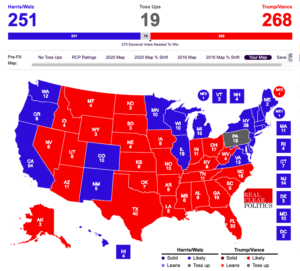
The upcoming US Presidential elections, set to take place in the next few days, seem both simple and complex. Simple, because it all boils down to just one state – Pennsylvania. In the 2020 elections, Joe Biden struggled to scrape through five swing states – Pennsylvania, Georgia, Michigan, Wisconsin, and Arizona. These five states determined the results of the last two elections. In 2016, Hillary Clinton lost all of these states to Trump, while in 2020, Biden won all five against Trump. Although it initially appeared that these states would play the same role this time around, a closer look at the electoral map suggests that it will ultimately come down to Pennsylvania, where the tipping point lies for both candidates.

Georgia and Arizona appear to be leaning towards Trump, while Harris may take Wisconsin and Michigan. Even as I divide these states into two camps, I am more confident that Trump will secure his two states, while Harris may face difficulties in securing hers. It’s possible that Harris may falter in Wisconsin, a state that Biden won by only twenty thousand votes. This implies that if just ten thousand of Biden’s votes shift to Trump, it would result in a win for Trump. Nevertheless, if I adopt an optimistic forecast for Harris, this is how the electoral map appears:

On the other hand, the elections are complex because it is difficult to determine which way the wind is blowing. As seen in both 2016 and 2020, Trump performs better in actual results compared to opinion polls. However, pollsters now claim to have adjusted for this discrepancy, and this year’s polls are said to reflect a more accurate picture. What is that picture? That the elections remain unpredictable.

The only thing going well for Trump is that he is as unconventional as any candidate can get. He has always come across as unpolished and brute, which is what half of the US loves. This quality is sufficient for all of them to ignore any number of fallacies he may show. Democrats have hardly found a way to deal with this. Neither their reason nor their articulation is pleasing enough for his supporter to reconsider his support. When Trump is on the ballot, the US does not vote as per the standardised en-blocs of pro-guns or anti-guns, pro-abortion or anti-abortion, or pro-tax cuts or anti-tax cuts. It comes down to perceptions that societal groups have of Trump.

Donald Trump is an absolutely fascinating candidate. He possesses characteristics that one may dislike but cannot ignore. Whatever the election results may show, he may, for historical purposes, become the biggest exception to voting patterns in the US. He attracts a notable share of the black vote, despite his racial stance and his opponent being half-black. He receives strong support from the working class, a demographic that Democrats from Clinton in 1992 to Obama in 2012 claimed. Immigrants from Mexico and India support him despite his call for “America for Americans”, a clear attack to what the right sees as un-American.

He is a resilient man with a level of impunity unmatched by any other candidate. He is evaluated with the same tolerance as a drunk driver, to whom we feel grateful if he avoids a crash. Meanwhile, Kamala Harris is more akin to a sober Formula 1 driver who would face intense scrutiny for every minor error while driving a hatchback through a crowded street. No reality show will ever come close to the drama of this year’s elections.

All the experts, pollsters, and commentators are scrambling to say anything definitive because there is nothing definitive about this election. Some discussions, especially on the 538 Podcasts, have even gone on to look at the weather forecast of Philadelphia, the capital of Pennsylvania, to see if it would rain on the election day, the 5th of November. And if it does, it is likely that Trump may win because those who are likely to vote for Harris may not be motivated enough to beat the rain and go out to vote. I am sure some analyst will soon release a detailed margin of vote-shift for every millimeter of rain Pennsylvania receives. Truly, we have saturated all data points.

With only a few days remaining, I am engrossed in everything related to the US elections. As in 2020, my body clock has adjusted to the New York time zone. And just as I did in 2016, I am hoping that Trump will be victorious once more — not for any policy reasons, but because his presence in the White House would make America interesting again.

A Bud Buddy of Tamarind

When I was about five years old, my father was transferred to Nandikotkur in Kurnool District in present-day Andhra Pradesh. The Residential building was on the back side of the Court and quite aloof from the town or even the main road. It was so further back from the Court that it was hardly even part of the Court complex. The entire empty area around the house was a dense forest. But the area immediately around the house was vacant land. My parents did not have a past-time, so they planned to plough the vacant land and plant some farms. This was not some kitchen garden. It was at a larger scale.

In the three years and a few months that we stayed there, we had grown groundnuts, kidney beans, pigeon peas, and several vegetables on a large scale. The produce would be filled in large gunny bags, much of which was eaten by us throughout the year, and some was given to close people.

On the sides, we also planted some fennel, banana plants, tomatoes, brinjal, bottle gourd, chillies, peas, etc. All of these would be used for daily cooking. I was highly interested in the growth of every single plant and would track it almost every single day. One distinct memory is that I had sowed some Tamarind seeds at the back of our house, one of which sprouted and grew well. By the time we left that place, in the year 2001, the plant was almost as tall as I was then. Of many things that I felt sad about leaving, one was this Tamarind plant which I called mine. Even my parents would call it “Asad ka imli ka jhaad”. It was my friend that grew up with me.

I had so much affection for it that, after we were transferred from there, someone from the staff at Nandikotkur court would call my dad to wish on New Years’ or Eid, and I would prod him to ask about my plant. They even went to see it and verified that it had become a tree. When I first got a computer at home, in the year 2004/2005, it had dial-up internet which was as slow as a snail. I had downloaded Google Earth and was fascinated with how I could see the entire planet by swiping the cursor. One of the places I had browsed was Nandikotkur. I went to my school and then to my house. I zoomed into my house to check the backyard. I could not see the specific trees, but I could see the general area which had several trees. I was sure that one of those trees was my tamarind tree. I was emotional to see it. It meant a lot to see it grow to such density and height. From a small seed that I had sowed, the plant that sprouted went on to become a healthy tree.

I am sure that tree lives to this date. I check Google Maps again and I can see that it is there. It must be there. I am certain that it has a wide canopy with its shade as sweet as a warm blanket on a cold winter day. I know that it must be home to several chirpy birds which built their nests in the arms of the branches with the twigs that fall from this tree. They must also be feeding on the sweet tamarind that it produces year after year. The seeds of that tamarind would’ve led to a lot of such plants to sprout. I hope the tamarind harvest is taken by the residents of the houses nearby and they make a sweet pickle out of it. I hope the tang of the juice that comes from its tamarind makes their food a bit more tasty. I hope there are kids who climb it to play peek-a-boo or to bring down a kite that’s stuck in it. I hope there’s a swing tied to it with kids challenging each other as to how far in the air they can swing. I hope there’s a mother roaming around the tree with her baby in her arms. I hope there are a few old ladies who draw a Ludo chart and play the game using the half-split seeds of the same tree. I hope it gives shelter to those who are tired from the struggles of life. I hope it provides respite to despair and hopes to dreams.

I hope it lives for eternity and meets me in heaven after I die.

Luxettipet: The Greener Pasture

This blog has been a quiet place where the sound of each page of my life turning would echo. Here, I have chronicled both events I go through and my thoughts on them. But it’s been a while since I have done that. This long hiatus which lasted several months is based on a good reason. There are things that have happened in my life that made my heart beat a little faster than it did before. It was both uncontrolled as well as self-induced. Uncontrolled because I was responding to life without much choice. Self-induced because I liked being in such position so much that sharing it might jinx it away. I would be lying if I say that this fear has gone away now. It stays, and I have accepted that it shall continue to stay.

I write this as I sit in my room on a pleasant winter evening. I look out of the window to see plenty of trees, both still and alive. A custard apple that awaits to ripen and a guava that shines yellow with the calm sunlight falling on it. I am in a town called ‘Luxettipet’. I have been transferred here, quite out of turn, from Mancherial. Evidently, the High Court doesn’t want any place which has only one court to be vacant, and since Luxettipet was vacant for about two months, they could flick me right in its lap. At first, I was taken aback. But once the dust settled, I was thankful for this change. The serene town has peaceful people and calm surroundings which so many would envy.

The Court here has good infrastructure. A building which looks like a Court, Advocates who care about their clients as they should, and a staff that’s both cooperative and understanding. Mancherial was similar in much of these, except for the glaring lack of infrastructure. At every Lok Adalat, when I would summon over a hundred accused caught in Drunken Driving cases, I was afraid that the building would collapse with their weight like it was hit by a 9.0 magnitude earthquake. They even dug out a hole across the floors in that shaky building to construct a lift. I wouldn’t be surprised if a few of these accused even fell in that hole without us even being aware of it even to this day. Most of my workout for the day would be climbing the building with chipped-off steps and crossing the busy road to meet the District Judge having juggled through the high-speed vehicles. While getting down the steps, I thought it would’ve been rather easier to go to the roof and jump from there with a parachute to glide down with a soft landing straight into my car.

But all that is gone. I get to walk to the Court in seconds since the chamber door opens in the house compound. The mornings are calm and the evenings are happy. I have many reasons to be thankful to the Almighty and this is one of them. And, God willingly, this is just the start.

My Dawn of Peace

A day is at its sweetest at dawn. The pink hues with hopeful birds chirping away to pleasant pastures and the silence of the calm skies as the breeze brushes through the leaves of confident trees make life blissful. The pursuit is not just of happiness, but of peace. Peace which warms the heart. Peace which imbibes hope. Peace which creates security. And peace which makes one feel blessed and loved.

My life dawned a few months ago as I met one piece of peace. A piece that completes me in a way I never thought I could be complete. A person who accepts me for everything I am, which I must admit, is a big ask. A girl who is as cheerful as a bright rainbow and as caring as a soft lullaby. A star that shone for my dawn.

We got engaged to be married on the 28th of November. And I eagerly wait for the day we start living together. My life – check that – our lives will never be the same. May we be blessed with all the happiness and love. May the Almighty keep every evil eye away. May we be together till our dying breath. And, for us, may everything be better than what we wish.

Ameen.

Made America Great Again?

What does it take to be a mother? The physical and emotional energy that a woman has to spend for nine long months carrying a baby can neither be measured nor quantified. This does not mean that women have to be patronised or patted on the back for what they do. The State must only provide all resources to ensure that the health of both the mother and the baby are at their best throughout. All this looks fairly simple. But, it is not.

Way back in the second year of my college, I had written a paper for the Law & Poverty course (click here). It looked at the Right to Abort and the various strands of arguments to support and oppose it. While the US discourse talks about liberty, privacy, and undue burden, the Indian law has a fairly simple motivation. As Parliament passed the Medical Termination of Pregnancy Act in the year 1971, it was said that this law will help reduce the population boom simply because of all the abortions that will now take place. Neither bodily autonomy nor personal liberty was to be seen in this discussion. Despite this, there is no absolute right to abort in India. For the right to be exercised, a woman has to prove either grave injury to her physical or mental health or that the child may be born with serious physical or mental abnormalities. Failure of contraceptives or that the pregnancy was a result of rape are additional grounds mentioned in the law.

Surely, there is much to be desired in the Indian law. Recognising the right to bodily autonomy within the ambit of personal liberty will be a step toward upholding Constitutional Morality. On the other hand, the US seems to have stepped back from it.

Dobbs v. Jackson is a dreadful read. It is all too glaring that the majority had decided what conclusion they must reach and used plenty of illogical means to get there. The prime basis for not recognising the Abortion right is the absence of such a right in the “deeply rooted history and tradition of the country” for it to be included in the “ordered liberty”. And the question is: why does it have to be deeply rooted? Surely, you can defend racism, sexism, and heteronormativity by simply stating that they are too deeply rooted to frame any right against them! This is a real threat since Brown v Board of Education (which outlawed segregation) and Obergefell v Hodges (which recognised same-sex marriage) can also be held to be per incuriam simply because they identified rights which were never deeply rooted in the American history.

Then there is a question of “ordered liberty”. The Fourteenth Amendment speaks about liberty, but does not mandate it to be ‘ordered’. This innovation that liberty has to be ordered is a sly standard to curtail substantial liberty. Roe v Wade spoke extensively on the potential life, i.e., the unborn child. For them, the balance of interests was tilted in favour of the woman in whose body this potential life grew. But in Dobbs, the majority shrugs away from looking at this balance. They throw the ball back to the State Legislatures which will decide whether or not a woman has control over her own body for another life to grow. In doing so, they proudly claim that the question has to be answered by the people which increases the democratic process. No one seemed uncomfortable in throwing a question of individual liberty to the mercy of the majority!

Dobbs has unabashedly attacked Roe on five direct counts: nature of court’s error, quality of reasoning, workability, effect on other laws, and reliance interests. It says that Roe created a winning side and a losing side. And this losing side (the pro-life) lost their democratic right to approach their representatives to express their interest in a specific law on abortion. It is dubious how the Court curtails the interpretation of liberty and curbs the bodily autonomy of women simply because the electors cannot approach their representatives with their views. And with this, they created another losing side – the women who have unwanted pregnancies, but are forced to carry on with them simply because it is no more their choice to do otherwise.

Dobbs put the rights regime back to what it was in the year 1973. With the young judges appointed by Trump playing by the script, the Supreme Court may take another 49 years to set the course right. The same court which has influenced the courts across the world has taken a step into darkness. And if Dobbs too has the same influence over the courts of the world, many countries may follow where the US seems to go. This is the biggest legacy that Trump leaves for the decades to come. Of all the walls that Trump wanted to build, this is the strongest one yet. Generations will suffer trying to jump over it, and the gloom will last until it is taken down.

The Haze of Modesty

6th of August, 1996 was an odd day in the city of Chandigarh. Outside the Court of Judicial Magistrate, a band assembled to sing tunes of victory. This was a Police band which is regularly summoned to public functions either to commemorate National Holidays or to pay respects to a high dignitary. But its purpose on this day and at this place was drastically different. It was to play their music and rejoice at a judgement slated to be pronounced that day in favour of the accused acquitting him of all charges. The glaring irony in this spectacle is how the Police Band, which is a part of the Police Department, had gathered to celebrate the failure of the Prosecution.

Things did not go as planned. The accused – Mr Kanwar Pal Singh Gill – was convicted and sentenced to rigorous imprisonment of three months for an offence under Section 354 and of two months for an offence under Section 509. KPS Gill was the ‘supercop’ who had been instrumental in washing away much of the Khalistani separatists by conducting Operation Black Thunder, and it was a setback for this towering ruthless IPS officer to be brought down by Rupan Deol Bajaj, the not-so-powerful IAS officer. The Court held that the allegation that Gill had slapped Bajaj on her bottom in an elite party of civil servants was proved and Gill had to serve his time in the clink. Of course, there were three stages of appeal after this, which went on to reduce the gravity of the sentence, ultimately erasing the imprisonment and leaving only Rs. 700/- as a fine and Rs. 2 Lac as compensation to a women’s rights organisation.

The entire case, which took almost two decades from the incident to the judgement of the Supreme Court, relied on the outrage of ‘modesty’. Modesty. It’s a word that I do not understand. What is it to have modesty and how does one take that modesty away from the other? With what act and after what point do we say that the modesty of a woman has been ‘outraged’? Why is it that only women are blessed (cursed?) with this modesty? Are men so inherently immodest that we must refrain from even ascribing modesty to them?

I am often required to examine the accused and frame charges as a part of my day job. This examination entails questioning the accused as to whether he has committed the offence as alleged or not. Since most are not familiar with English, I do this either in Telugu or Hindi. Unfortunately, I have not found an equivalent phrase for ‘outrage of modesty’ in these languages. I could ask someone to give me the best translation for it. But before I do that, I ask myself if I can explain ‘outrage of modesty’ to describe what it means. If not in any other language, can I, at the very least, do it in English? I fail again.

There are two issues I have with not having any clarity on this. One, I am unsure how and what standard I must use to try the accused who have been charged with such offences. The safer way is to simply stop looking for the line where modesty turns into immodesty, and rather focus on whether an act falls on the wrong side of such line or not. Two, I am uncomfortable with the reality that everyone – the bar, the police, the litigants – is so eased into the use of ‘modesty’ as they throw the word around without knowing the meaning of such a word. What does it say about the legal profession that we use a word to charge, try, and convict the accused without even understanding the meaning of that word? And more importantly, what does it say to the women who are victims of harassment to say that what was done to them is a crime, not because their space was violated without their consent, but because they possess some ‘modesty’ which is ‘outraged’?

It is said that the language that such colonial laws use has Victorian semantics and morality. We have neither tried to replace such language nor attempted to understand it. And for Rupan Deol Bajaj, it proved to vindicate her stand. It was found that her modesty was indeed outraged and the same had to be punished. But the narrative is not all that comforting.

In an interview cited in an article titled ‘The Modesty of Mrs Bajaj’ by Martha Nussbaum, Bajaj said, “I am not a woman from the roadside. I have had 6,000 men working under me.” Similarly, in a different interview with the Tribune, she said, “I just had to carry on. It was essential for the dignity of my office. If I had not protested then who is supposed to, my class IV employee or peon?”

Well, yes, ma’am! You had to carry on. But so should a class IV employee or a peon or a ‘roadside’ woman. Let us not bestow a higher standard of modesty by the office one occupies, but respect them for the human beings they are. While we may struggle to find the meaning of ‘modesty’, we must agree that it is not desirable to prescribe different notions of modesty by the class or caste of a woman. If doing away with Victorian Morality is a bit much, let us at least apply the same morality to everyone equally. Until then, not every Gill will be caught.